

Air travel serves as a central pillar of transportation across the United States.
Business trips, family vacations, cargo movement, and international connections all rely on an extensive airport network that operates at a massive scale.
Passenger volumes rank among the highest worldwide, supported by infrastructure designed to move people efficiently across long distances.
Questions often arise about the number of airports nationwide and which facilities handle the largest number of travelers each year.
Let us see if we can find answers to these questions.
How Many Airports Are There in the U.S.?
Federal Aviation Administration records indicate roughly 19,000 airports operating nationwide, covering a wide spectrum of functions and scales. Aviation infrastructure across the United States surpasses that of every other nation.
Facilities range across remote rural airfields, regional airports supporting small communities, and major international hubs handling global traffic flows.
FAA classifications help clarify how these airports are distributed across public and private use.
Public-use airports allow access for general aviation pilots, charter operators, emergency services, and scheduled airlines. Commercial service airports represent a smaller share but play an outsized role in passenger movement.
Commercial service facilities fall into clearly defined categories based on annual passenger boarding totals:
- Primary commercial airports exceed 10,000 enplanements per year
- Non-primary commercial airports record between 2,500 and 10,000
General aviation airports account for most locations nationwide and support pilot training, medical transport, firefighting operations, agricultural flights, and corporate aviation.
Military airports operate under separate authority and focus on defense readiness and training missions.
The 10 Busiest Airports in the United States
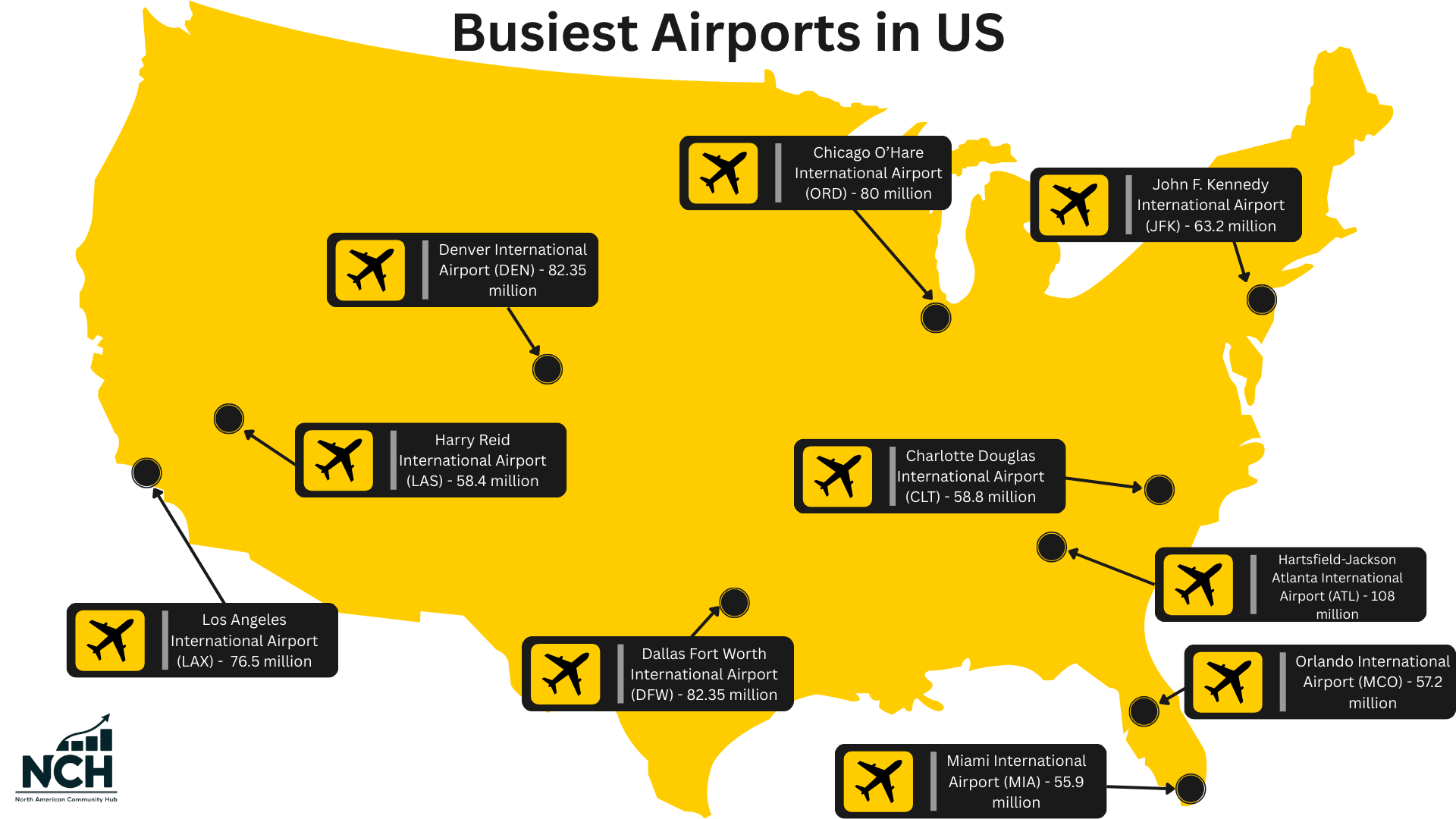
Passenger totals recorded reveal a concentrated group of airports responsible for a large share of air travel nationwide.
Rankings reflect total passengers moved rather than airport land area or terminal count.
According to the data presented by Remitly, those numbers are:
| Rank | Airport | Location | Passengers |
| 1 | Hartsfield-Jackson Atlanta International Airport (ATL) | Atlanta, Georgia | 108 million |
| 2 | Dallas Fort Worth International Airport (DFW) | Dallas, Fort Worth, Texas | 82.35 million |
| 3 | Denver International Airport (DEN) | Denver, Colorado | 82.35 million |
| 4 | Chicago O’Hare International Airport (ORD) | Chicago, Illinois | 80 million |
| 5 | Los Angeles International Airport (LAX) | Los Angeles, California | 76.5 million |
| 6 | John F. Kennedy International Airport (JFK) | New York, New York | 63.2 million |
| 7 | Charlotte Douglas International Airport (CLT) | Charlotte, North Carolina | 58.8 million |
| 8 | Harry Reid International Airport (LAS) | Las Vegas, Nevada | 58.4 million |
| 9 | Orlando International Airport (MCO) | Orlando, Florida | 57.2 million |
| 10 | Miami International Airport (MIA) | Miami, Florida | 55.9 million |
1. Hartsfield Jackson Atlanta International Airport (ATL)

Hartsfield-Jackson Atlanta International Airport recorded about 108 million passengers, making it the busiest airport in the country.
Delta Air Lines anchors its operations and uses Atlanta as its primary global hub.
Flight schedules support dense domestic coverage combined with international routes across Europe, Asia, and Latin America.
High-frequency connections allow efficient transfers that keep passenger flow consistently high throughout the year.
2. Dallas Fort Worth International Airport (DFW)
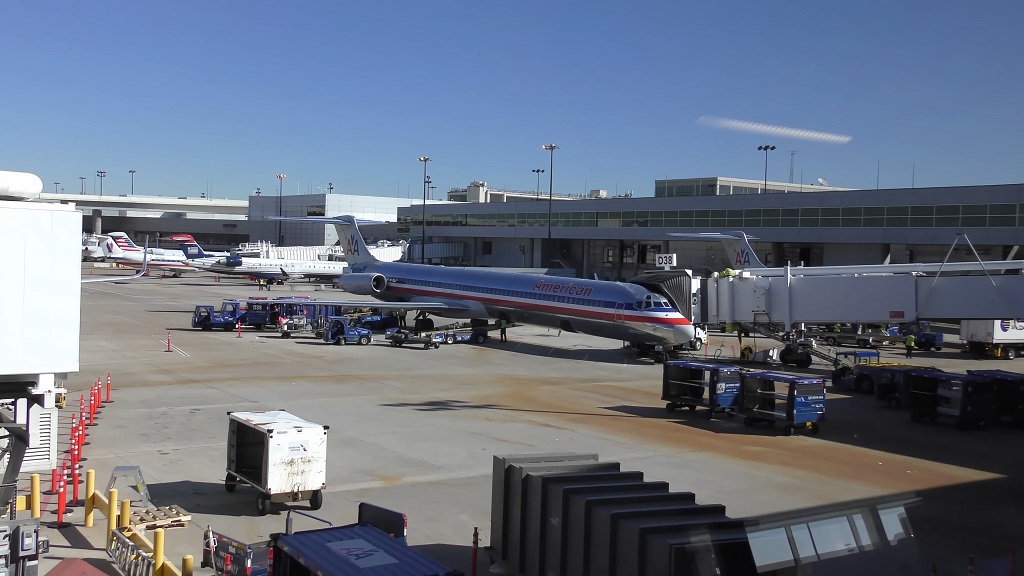
Dallas-Fort Worth International Airport handled roughly 82.35 million passengers in 2023.
American Airlines relies on DFW as its largest hub, concentrating a significant portion of domestic and international traffic at the airport.
Central positioning within the continental United States supports coast-to-coast connectivity, while nonstop routes reach major global markets.
3. Denver International Airport (DEN)
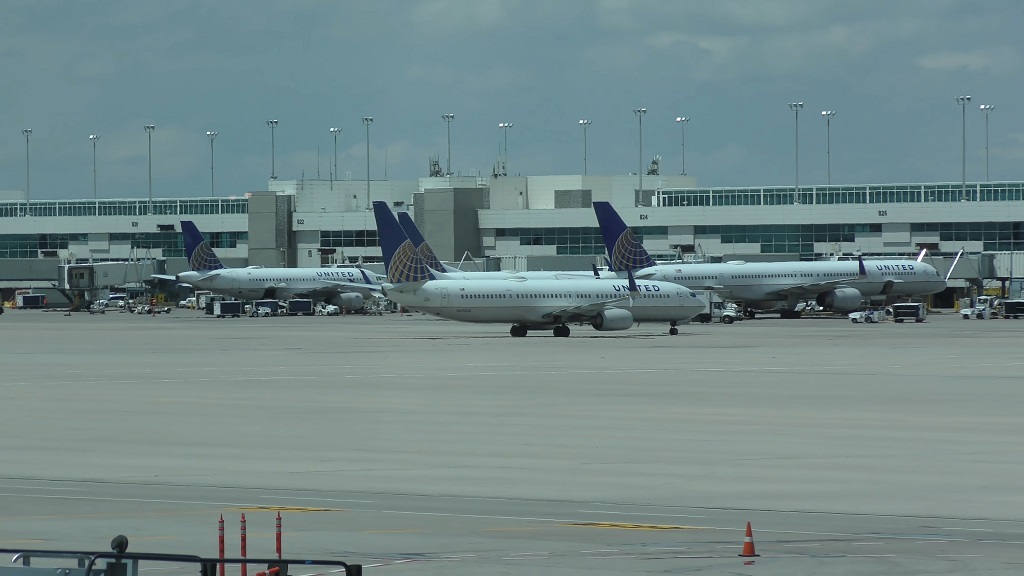
Denver International Airport matched Dallas-Fort Worth with about 82.35 million passengers.
United Airlines operates a major hub at DEN, supported by Southwest and Frontier Airlines.
High-altitude operations and extensive runway capacity allow the airport to manage heavy traffic volumes.
Geographic placement supports efficient routing between eastern and western regions of the country.
4. Chicago O’Hare International Airport (ORD)

Chicago O’Hare International Airport processed close to 80 million passengers during 2023.
United Airlines and American Airlines both maintain large hub operations, creating one of the most connected route networks in the world.
Nonstop service reaches more than 214 destinations globally, reinforcing O’Hare’s role as a critical transfer point for domestic and international travel.
5. Los Angeles International Airport (LAX)
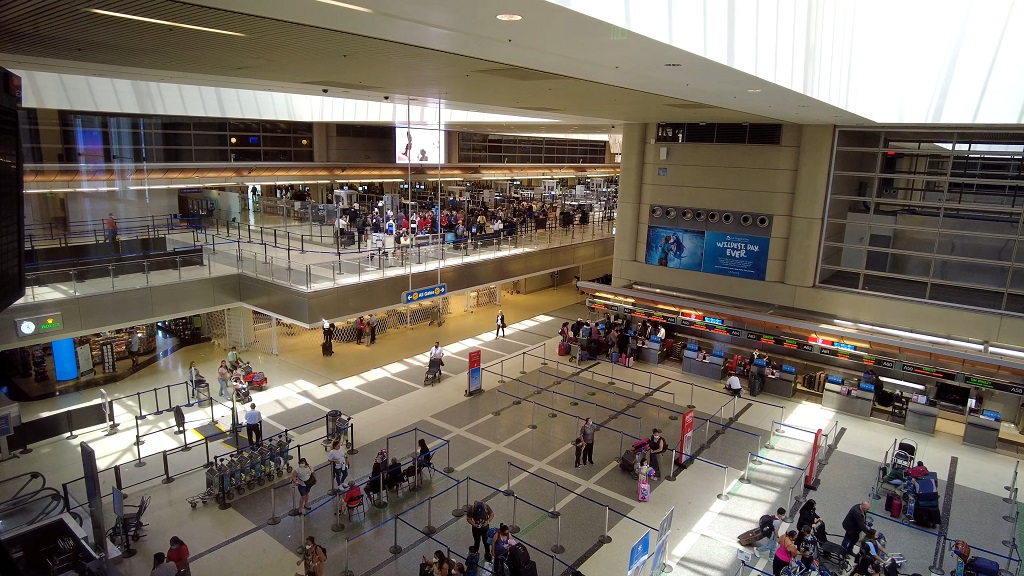
Los Angeles International Airport reached about 76.5 million passengers.
Multiple major carriers operate large schedules, supporting extensive domestic service alongside long-haul international routes.
Pacific Rim connectivity, transcontinental demand, and regional travel across California contribute to consistently high passenger numbers.
6. John F. Kennedy International Airport (JFK)
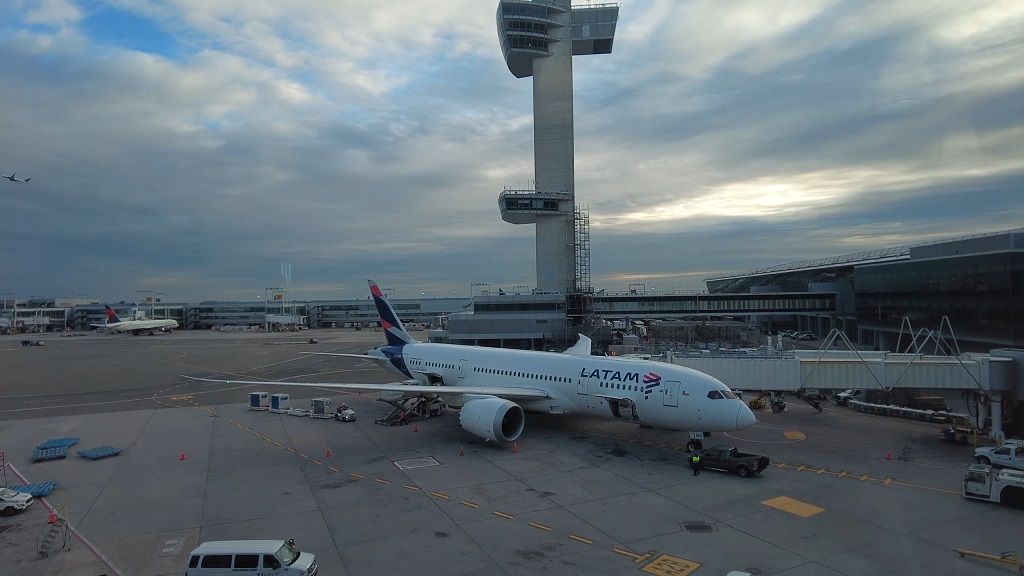
John F. Kennedy International Airport handled around 63.2 million passengers and serves as one of the nation’s primary international gateways.
Delta Air Lines, American Airlines, and JetBlue operate major facilities, with a strong emphasis on transatlantic and long-haul routes.
International traffic accounts for a significant share of overall passenger volume.
7. Charlotte Douglas International Airport (CLT)

Charlotte Douglas International Airport recorded about 58.8 million passengers.
American Airlines uses CLT as a key connecting hub, particularly for East Coast travel.
Short connection times and high flight frequency support efficient passenger movement across domestic routes.
8. Harry Reid International Airport (LAS)

Harry Reid International Airport served roughly 58.4 million passengers in 2023.
Southwest Airlines leads operations, supported by Frontier and Spirit.
Leisure travel drives demand, with frequent service tied to tourism, conventions, and entertainment events in Las Vegas.
9. Orlando International Airport (MCO)

Orlando International Airport processed approximately 57.2 million passengers.
Leisure travel dominates traffic patterns, supported by strong demand linked to theme parks, resorts, and family travel.
JetBlue and other carriers maintain extensive domestic coverage to meet seasonal and year-round demand.
10. Miami International Airport (MIA)

Miami International Airport handled about 55.9 million passengers and functions as a primary gateway between the United States and Latin America.
American Airlines operates a major hub, supporting extensive international connectivity alongside domestic service.
Cargo operations also contribute to overall airport activity, reinforcing Miami’s role in global air transport.
What Makes an Airport Busy?

Airport activity levels depend on several measurable factors that go beyond physical size.
Total annual passenger traffic remains the most widely used benchmark and includes both boarding and arriving travelers.
Aircraft movements also provide insight into operational intensity, capturing how often runways are used for takeoffs and landings.
Key metrics commonly used to evaluate airport activity include the following elements.
- Total annual enplanements and deplanements
- Number of aircraft takeoffs and landings
- Daily flight frequency across domestic and international routes
Connectivity strongly influences traffic levels, especially at hub airports that link dozens or even hundreds of destinations.
Hub status for large carriers such as Delta Air Lines, American Airlines, and United Airlines drives dense schedules that operate throughout the day. Coordinated arrival and departure banks allow airlines to move large numbers of connecting passengers efficiently.
However, operational efficiency depends heavily on a functioning federal workforce, particularly air traffic controllers employed by the FAA.
During events like a government shutdown and flight risks, aviation safety and staffing levels may be severely compromised, with consequences including increased delays, reduced traffic capacity, and in extreme cases, higher accident risk.
Coordinated arrival and departure banks allow airlines to move large numbers of connecting passengers efficiently.
Physical size alone does not guarantee higher passenger volume.
Denver International Airport covers the largest land area of any U.S. airport, yet Hartsfield-Jackson Atlanta International Airport processes far more passengers each year due to hub concentration, scheduling density, and airline strategy.
Why These Airports Lead in Passenger Volume
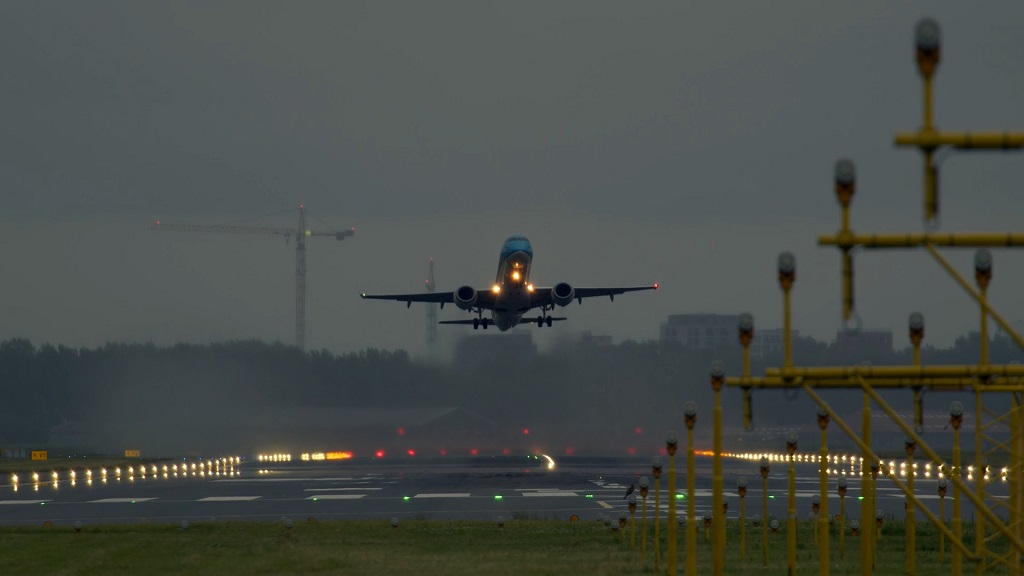
Strategic location plays a major role in sustaining high passenger volumes across leading U.S. airports.
Geographic positioning allows airlines to schedule efficient routes that minimize travel time while maximizing connection opportunities.
Atlanta benefits greatly due to its proximity to a large portion of the U.S. population within a short flight radius.
Dallas, Fort Worth, and Denver also benefit due to placement that supports both coast-to-coast service and long-haul international routing.
Geographic advantages shared by top hubs include several measurable factors:
- Ability to reach most major U.S. cities within two to three flight hours
- Favorable positioning for east-west and north-south connections
- Reduced need for backtracking on long-distance itineraries
Major airline hubs further amplify passenger demand through concentrated operations. Delta Air Lines focuses a significant share of its global schedule through Atlanta.
American Airlines channels large volumes through Dallas-Fort Worth, Charlotte, and Miami.
United Airlines relies heavily on Chicago O’Hare and Denver to support both domestic networks and overseas routes.
Hub concentration allows airlines to schedule frequent departures and arrivals that keep aircraft utilization high throughout the day.
International connectivity also plays a critical role in passenger totals. Airports such as JFK, Los Angeles, and Miami link the United States directly with Europe, Asia, and Latin America.
These airports support a mix of leisure travel, business travel, and long-haul connections that generate sustained demand year-round.
Chicago O’Hare maintains nonstop service to more than 214 destinations worldwide, placing it among the most globally connected airports.
Tourism demand adds another layer of volume growth. Orlando and Las Vegas attract millions of visitors each year, driving strong seasonal and year-round travel patterns. Leisure-focused routes often feature high flight frequency and competitive pricing, which further increases passenger counts.
Infrastructure investment supports continued growth at many top airports. Denver International spans more than 33,500 acres, creating flexibility for future expansion.
Ongoing development efforts across major hubs focus on several operational priorities:
- Terminal expansions to increase gate capacity
- Runway projects that improve traffic flow and reduce delays
- Security upgrades designed to process passengers more efficiently
Major Airports Across the United States by State
Alabama
- Birmingham-Shuttlesworth International Airport (BHM)
- Huntsville International Airport (HSV)
- Mobile Regional Airport (MOB)
- Montgomery Regional Airport (MGM)
Alaska
- Ted Stevens Anchorage International Airport (ANC)
- Fairbanks International Airport (FAI)
- Juneau International Airport (JNU)
- Ketchikan International Airport (KTN)
- Sitka Rocky Gutierrez Airport (SIT)
Arizona
Arkansas
California
- Los Angeles International Airport (LAX)
- San Francisco International Airport (SFO)
- San Diego International Airport (SAN)
- Oakland International Airport (OAK)
- San Jose International Airport (SJC)
- Sacramento International Airport (SMF)
- Long Beach Airport (LGB)
- John Wayne Airport (SNA)
- Ontario International Airport (ONT)
- Palm Springs International Airport (PSP)
- Fresno Yosemite International Airport (FAT)
- Burbank Bob Hope Airport (BUR)
- Santa Barbara Municipal Airport (SBA)
Colorado
- Denver International Airport (DEN)
- Colorado Springs Airport (COS)
Connecticut
Delaware
- Wilmington Airport (ILG)
Florida
- Miami International Airport (MIA)
- Orlando International Airport (MCO)
- Fort Lauderdale-Hollywood International Airport (FLL)
- Tampa International Airport (TPA)
- Palm Beach International Airport (PBI)
- Southwest Florida International Airport (RSW)
- Jacksonville International Airport (JAX)
- Sarasota-Bradenton International Airport (SRQ)
- Pensacola International Airport (PNS)
- Destin-Fort Walton Beach Airport (VPS)
- Key West International Airport (EYW)
- Gainesville Regional Airport (GNV)
- Tallahassee International Airport (TLH)
Georgia
- Hartsfield-Jackson Atlanta International Airport (ATL)
- Savannah/Hilton Head International Airport (SAV)
Hawaii
- Daniel K. Inouye International Airport (HNL)
- Kahului Airport (OGG)
- Kona International Airport (KOA)
- Lihue Airport (LIH)
- Hilo International Airport (ITO)
Idaho
- Boise Airport (BOI)
Illinois
- O’Hare International Airport (ORD)
- Chicago Midway International Airport (MDW)
- General Wayne A. Downing Peoria International Airport (PIA)
- Quad City International Airport (MLI)
Indiana
- Indianapolis International Airport (IND)
- Fort Wayne International Airport (FWA)
- South Bend International Airport (SBN)
Iowa
- Des Moines International Airport (DSM)
- Eastern Iowa Airport (CID)
Kansas
Kentucky
- Louisville Muhammad Ali International Airport (SDF)
- Cincinnati/Northern Kentucky International Airport (CVG)
- Blue Grass Airport (LEX)
Louisiana
- Louis Armstrong New Orleans International Airport (MSY)
- Baton Rouge Metropolitan Airport (BTR)
- Shreveport Regional Airport (SHV)
Maine
Maryland
Massachusetts
Michigan
- Detroit Metropolitan Wayne County Airport (DTW)
- Gerald R. Ford International Airport (GRR)
- Flint Bishop International Airport (FNT)
- Kalamazoo/Battle Creek International Airport (AZO)
- Cherry Capital Airport (TVC)
Minnesota
Mississippi
Missouri
- St. Louis Lambert International Airport (STL)
- Kansas City International Airport (MCI)
- Springfield-Branson National Airport (SGF)
Montana
- Billings Logan International Airport (BIL)
- Bozeman Yellowstone International Airport (BZN)
- Missoula International Airport (MSO)
Nebraska
- Eppley Airfield (OMA)
- Lincoln Airport (LNK)
Nevada
New Hampshire
New Jersey
- Newark Liberty International Airport (EWR)
- Atlantic City International Airport (ACY)
- Trenton-Mercer Airport (TTN)
New Mexico
New York
- John F. Kennedy International Airport (JFK)
- LaGuardia Airport (LGA)
- Newark Liberty International Airport (EWR)
- Buffalo Niagara International Airport (BUF)
- Albany International Airport (ALB)
- Syracuse Hancock International Airport (SYR)
- Greater Rochester International Airport (ROC)
North Carolina
- Charlotte Douglas International Airport (CLT)
- Raleigh-Durham International Airport (RDU)
- Wilmington International Airport (ILM)
- Asheville Regional Airport (AVL)
- Piedmont Triad International Airport (GSO)
North Dakota
Ohio
- Cleveland Hopkins International Airport (CLE)
- John Glenn Columbus International Airport (CMH)
- Dayton International Airport (DAY)
- Akron-Canton Airport (CAK)
- Rickenbacker International Airport (LCK)
Oklahoma
- Will Rogers World Airport (OKC)
- Tulsa International Airport (TUL)
Oregon
- Portland International Airport (PDX)
- Eugene Airport (EUG)
- Rogue Valley International-Medford Airport (MFR)
Pennsylvania
- Philadelphia International Airport (PHL)
- Pittsburgh International Airport (PIT)
- Harrisburg International Airport (MDT)
- Lehigh Valley International Airport (ABE)
- Erie International Airport (ERI)
Rhode Island
- T.F. Green Airport (PVD)
South Carolina
- Charleston International Airport (CHS)
- Myrtle Beach International Airport (MYR)
- Greenville-Spartanburg International Airport (GSP)
- Columbia Metropolitan Airport (CAE)
- Hilton Head Airport (HHH)
South Dakota
Tennessee
- Nashville International Airport (BNA)
- Memphis International Airport (MEM)
- McGhee Tyson Airport (TYS)
- Chattanooga Metropolitan Airport (CHA)
- Tri-Cities Regional Airport (TRI)
Texas
- Dallas/Fort Worth International Airport (DFW)
- George Bush Intercontinental Airport (IAH)
- Austin-Bergstrom International Airport (AUS)
- San Antonio International Airport (SAT)
- Dallas Love Field (DAL)
- William P. Hobby Airport (HOU)
- El Paso International Airport (ELP)
- Lubbock Preston Smith International Airport (LBB)
- Midland International Air and Space Port (MAF)
- Valley International Airport (HRL)
- McAllen Miller International Airport (MFE)
- Corpus Christi International Airport (CRP)
Utah
Vermont
Virginia
- Washington Dulles International Airport (IAD)
- Ronald Reagan Washington National Airport (DCA)
- Norfolk International Airport (ORF)
- Richmond International Airport (RIC)
- Roanoke-Blacksburg Regional Airport (ROA)
Washington
- Seattle-Tacoma International Airport (SEA)
- Spokane International Airport (GEG)
- Tri-Cities Airport (PSC)
- Bellingham International Airport (BLI)
West Virginia
- Yeager Airport (CRW)
Wisconsin
- General Mitchell International Airport (MKE)
- Dane County Regional Airport (MSN)
- Appleton International Airport (ATW)
Wyoming
- Jackson Hole Airport (JAC)
The Bottom Line
Aviation in the United States relies on a vast network that includes thousands of small airfields and a concentrated group of major hubs.
More than 19,000 airports support national mobility, yet a limited number consistently move tens of millions of passengers each year.
Atlanta, Dallas Fort Worth, Denver, and Chicago remain at the forefront due to location, airline strategy, and capacity.
Passenger volumes continue to increase as air travel demand grows. Major hubs are expected to see continued expansion and heavier traffic in coming years, reinforcing their role as critical engines of mobility and economic activity.