

Alcohol in the United States in 2025 feels like it is changing shape more than disappearing.
Walk into a bar or a store, and the choices look different from what they did a few years ago.
Beer still has a big footprint, yet spirits and canned cocktails are everywhere, and many are stronger than what people used to grab without thinking.
Even as more adults say they drink less often, the overall per-person amount remains high.
Look state by state, and the gap gets hard to ignore. Border and tourist states sit near the top because visitors and cross-state buyers boost the numbers, while Utah and a few Southern and Appalachian states stay near the bottom under tighter rules and local habits.
Spirits now carry more of the alcohol load than beer, helped by the boom in ready-to-drink cocktails.
Overview of Alcohol Consumption per Capita in the US
| Metric | Latest Level Used In 2025 Tracking | Note |
| Pure alcohol per person (age 14+) | About 2.5 gallons per year | Heavy yearly load, near recent highs |
| Standard drinks per year | About 533 drinks | Around 1 to 2 drinks on most days |
| Average drinks per week | About 10 to 12 drinks | National range holding steady |
| Adults who drink at all | About 54 percent | Share of drinkers keeps falling |
| Ethanol from spirits per person | About 1.06 gallons | Spirits are now slightly ahead of beer in alcohol impact |
| Ethanol from beer per person | About 1.02 gallons | Beer is still huge in volume, lower in ethanol hit |
| Ethanol from wine per person | About 0.42 gallons | Smallest slice of total ethanol |
Beer, Wine, Spirits – What Americans Choose In 2025?
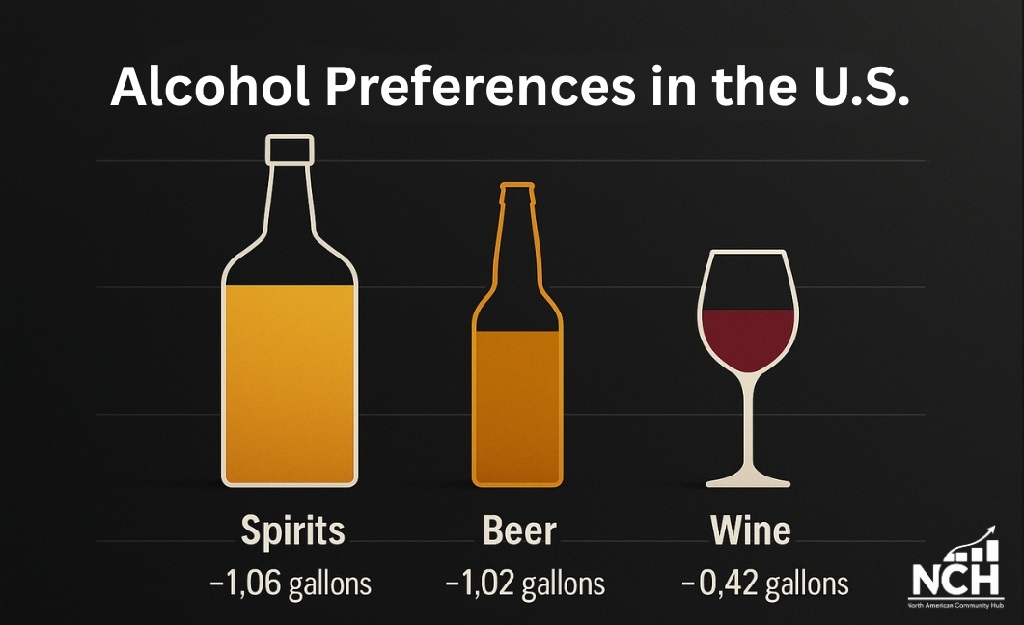
A cocktail, a shot, or a canned margarita carries more alcohol than a typical beer, so spirits can win the ethanol race without winning the raw volume race.
| Drink | Pure Alcohol Per Person (Yearly) | Rough Slice Of The Total | What People Are Doing With It In 2025 |
| Beer | ~1.02 gallons | ~4 in 10 | Still the go-to for parties and sports, but the slow slide keeps going |
| Spirits | ~1.06 gallons | ~4 in 10 | Tequila, whiskey, and vodka stay hot, plus canned cocktails keep pulling people in |
| Wine | ~0.42 gallons | ~2 in 10 | Loyal older crowd, younger buyers are less interested, everyday bottles feel price stress |
Spirits
Tequila and American whiskey keep getting more popular, both at home and in bars. Also, ready-to-drink cans make spirits easy for casual occasions that used to belong to beer.
Higher ABV means spirits gain ground even when bottle counts move slowly.
Beer
Big domestic brands keep losing share year after year. Craft stays popular, yet growth looks flat, and shelf competition is brutal.
Imports, hard seltzers, and RTDs keep stealing the “grab something light” moment.
Wine
Buying skews older, and younger adults do not pick wine as a default like prior generations. Mid-price wine takes hits from both sides: spirits for buzz, RTDs for convenience.
Spirits are dominating because they are stronger and easier to buy in new formats.
Beer is not so much in focus while wine is holding on, but mostly with older drinkers, and it has not found a firm grip on the younger population in 2025.
Fewer Drinkers, Heavier Drinking
The headline number for 2025 looks simple: fewer adults say they drink, yet per-capita alcohol intake stays stubbornly high.
Gallup polling published in 2025 shows about 54 percent of US adults reporting any drinking, the lowest level since Gallup began tracking in 1939.
At the same time, market data suggests the average number of drinks per adult per week has only dipped a little since the early 2020s, landing near a long-running band of roughly 10 to 12 drinks weekly.
That gap points to a concentration effect: a smaller drinking population carrying more of the total.
What The Numbers Show In 2025?
Survey and sales tracking line up on three points:
- Participation keeps falling. Health worries and lifestyle shifts, especially among younger adults and women, drive the drop in “yes, I drink” answers.
- Intensity stays high inside the drinking group. When people do drink, many choose higher-ABV spirits or RTD cocktails, which keeps ethanol intake from sliding quickly.
- Binge drinking remains common. National NSDUH reporting defines binge drinking as 4 drinks on one occasion for women or 5 for men, and shows millions still doing it monthly, especially among ages 18 to 25.
Why Drinking Gets Heavier For Some
A few forces keep pushing the weight toward heavier use:
- Economic and social stress. Short-term pressure like inflation often trims casual drinking while leaving heavy weekends or coping drinking untouched.
- Product shift. Spirits, tequila, whiskey, vodka, and canned cocktails take more occasions than used to mean beer, raising alcohol per serving.
- Smaller core of frequent drinkers. When fewer people drink at all, national averages depend more on the habits of regular users.
When Drinking Turns Into Harm
Heavy or binge patterns carry real risk, even when they feel normal in the moment.
CDC estimates tie excessive alcohol use to about 178,000 deaths per year in the US, through liver disease, cancers, heart harm, injuries, and alcohol-impaired crashes.
Binge episodes also raise near-term danger: blackouts, falls, violence, unsafe sex, and driving risk spike after just a few hours of high intake.
Warning signs show up in everyday life: needing more drinks for the same effect, drinking to steady mood, hiding use, or feeling sick and anxious without alcohol. When patterns start running the schedule, support matters, and early help works better than waiting for a crisis.
There is Help Available
Treatment ranges from outpatient counseling to medically supervised detox and residential programs.
One example people sometimes look at is Voyager Recovery Center, or similar rehab centers, which offer detox plus residential care. Programs like that are one option among many, and the best fit depends on the level of dependence, mental health needs, home support, and insurance.
For a starting point without a sales pitch, SAMHSA National Helpline (1-800-662-HELP) offers free, confidential guidance and referrals day and night.
Income, Education, And Drinking Habits
Money and schooling keep showing up in US drinking patterns in 2025.
People with higher incomes and college degrees drink more often, while people with lower incomes drink less often overall but take more damage when they do drink.
| Group | How Often People Drink | What Drinking Looks Like |
| Higher Income | More likely to drink at all and to drink weekly | More routine, smaller servings, more wine, and premium spirits |
| Lower Income | Less likely to drink at all | Fewer drinkers, heavier weekends among drinkers |
| College Graduates | Highest participation | More social and spread out through the week |
| High School Or Less | Lower participation | More binge-style episodes among drinkers |
Where The Trend Could Go Next

A few lanes are already visible for the next couple of years. None looks like a sudden national sobriety wave.
Most signs point to slow change, with the mix shifting faster than the total amount.
Participation Keeps Sliding
Polling in 2025 shows a record low share of adults who drink, and the drop has run for three straight years. Health worries are a big driver, especially among younger adults.
View this post on Instagram
No and Low Alcohol Grows Into a Permanent Aisle
Big producers are investing in dealcoholized beer and other low-ABV lines, betting that “drink less, keep the ritual” sticks.
RTDs Stay the Bright Spot
Forecast updates for 2025 show ready-to-drink cocktails as the only category still growing in volume, even while beer, wine, and spirits trend down.
Beer Keeps Drifting Down, Slowly
IWSR expects another small global drop in beer volume during 2025, with the United States a major part of the drag.
Wine Softens Further
Forecasts for 2025 keep wine as the weakest major category, tied to aging demand and weak pull from younger buyers.
People Trade Down on Price
Late 2025 sales reports show premium spirits slowing while cheaper bottles gain ground, a classic pressure move when budgets tighten.
Frequently Asked Questions
Bottom Line
People in the US still drink a lot in 2025, even though more adults are choosing not to drink at all.
The bigger change is what ends up in the glass: beer is now less common, while spirits and canned cocktails are everywhere.