

If you want the short answer, head south. Mississippi is the cheapest state to build a house in 2026, with construction running around $154 per square foot, while Hawaii sits at the top of the range at $230. Arkansas, West Virginia, Oklahoma and Alabama all cluster under $160.
That spread means the same floor plan can swing by close to $190,000 depending on which state line you happen to be standing on. Land, labor rates and local permit rules explain most of the difference, and one of those three costs far more than first-time builders usually expect.
Where should you build a house if you have a tight budget?
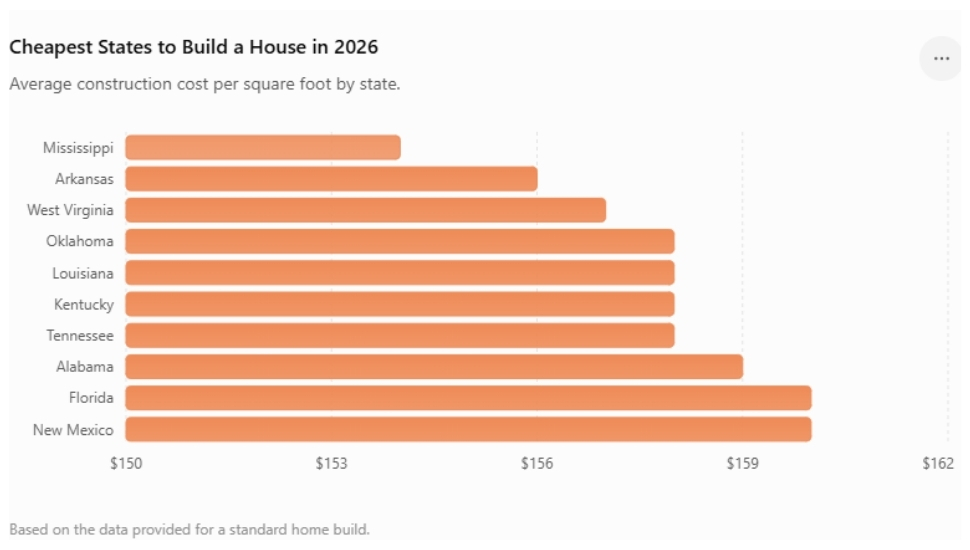
Construction costs follow a clear geographic pattern. The South Central region holds the most affordable building environment in the country, helped by low land acquisition costs of roughly $4,000 to $12,000 per acre, non-union labor markets, and permit fees that often land between $500 and $2,500 rather than the $10,000 to $25,000 common in coastal states.
Here is how the ten most affordable states compare on a standard build:
| State | Average Cost per Square Foot | Estimated Cost for a 2,500 Sq Ft Home |
| Mississippi | $154 | $375,000 to $625,000 |
| Arkansas | $156 | $375,000 to $650,000 |
| West Virginia | $157 | $425,000 to $650,000 |
| Oklahoma | $158 | $375,000 to $650,000 |
| Louisiana | $158 | $375,000 to $675,000 |
| Kentucky | $158 | $375,000 to $675,000 |
| Tennessee | $158 | $375,000 to $675,000 |
| Alabama | $159 | $375,000 to $675,000 |
| Florida | $160 | $375,000 to $675,000 |
| New Mexico | $160 | $400,000 to $625,000 |
Notice how tight the bottom of the table is. Six dollars per square foot separates Mississippi from Alabama, which on a 2,500 square foot home works out to about $15,000.
Choosing between neighboring southern states rarely decides your budget. Choosing between Alabama and New Jersey absolutely does.
Why the South Keeps Winning on Price
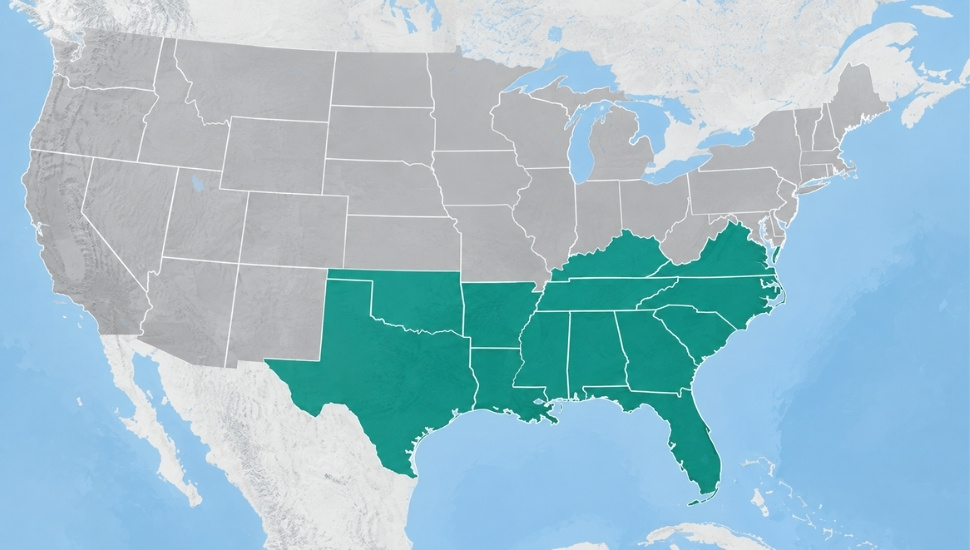
Labor is the first reason. Right-to-work states pay framing crews, electricians and finish carpenters less than union markets, and framing alone can be 30 to 40 percent cheaper outside union jurisdictions.
Foundations are the second. A southern slab-on-grade pour only needs to sit 12 to 18 inches deep. In Minnesota, North Dakota and Wisconsin, foundations must reach below a frost line of 42 to 60 inches, adding $8,000 to $15,000 before framing starts. Cold weather charges rent on your foundation every single time.
The third reason is simply demand.
Southern states with the lowest overall cost of living in the US also tend to have contractors who are not booked eighteen months out.
Land, Access and the Costs Nobody Budgets For
View this post on Instagram
Per-square-foot figures cover materials, labor and the structure itself. They usually leave out the dirt you build on, and that gap catches people off guard.
Raw acreage in rural Mississippi or Arkansas can be genuinely cheap. Making it buildable is where the money goes: a well, a septic system, a power run from the nearest pole, and a driveway that meets county specifications.
Many counties and homeowner associations also require a drawn site plan before approving a curb cut or an access road, which is why services like driveway site plans by Get A Site Plan exist at all.
County offices reject hand-drawn sketches far more often than first-time owners expect, and each rejection costs weeks.
A useful rule of thumb: if a parcel is priced well below everything around it, find out why before you fall in love with it. Cheap land is usually confessing something about water, access or soil.
Regulation Adds Six Figures to the Average New Build
View this post on Instagram
Here is the number that reframes the whole conversation.
NAHB research released in June 2026 found that regulations across federal, state and local government account for $131,734 of the price of a new single-family home, or 26.4 percent of the January 2026 average sales price of $499,500.
The trend matters as much as the total. Regulatory costs climbed from $93,870 in 2021 to $131,734 in 2026, an increase of more than 40 percent in about five years, while disposable income rose just 18.3 percent over the same stretch.
NAHB chairman Bill Owens, a builder from Worthington, Ohio, tied the finding directly to the country’s affordability problem.
Where the Rules Cost the Most
Regulatory burden is not spread evenly, and the same house can trigger wildly different compliance bills depending on the county:
- California builders face Title 24 energy compliance, CEQA review and local solar mandates that together add roughly $25,000 to $45,000.
- Florida coastal counties require impact-resistant windows and reinforced roof-to-wall connections, pushing costs up 8 to 12 percent.
- Seismic requirements in California, Washington, Oregon and Alaska add $15,000 to $35,000 for reinforced foundations and structural engineering.
Timing carries its own price tag. NAHB’s 2026 survey found it takes an average of 15.1 months to move from zoning application to site work, followed by another 11.5 months before a finished lot reaches a builder. Interest on a construction loan runs the entire time.
Cheap to Build Is Not the Same as Cheap to Own
Mississippi and Alabama look excellent on paper, and both hold up reasonably well after move-in. Florida is the state where the math gets complicated.
Construction sits comfortably in the affordable tier at $160 per square foot, but hurricane insurance premiums have become the dominant variable in the ownership budget, and Florida real estate market conditions show insurers pricing individual properties by flood zone rather than by region.
Utilities deserve a look too. Building in a state with cheap labor does not guarantee a cheap electric bill, and average monthly utility costs across the US vary by close to $300 a month between the cheapest and priciest states.
For a broader affordability check, the Q1 2026 housing cost index compiled by the Missouri Economic Research and Information Center puts Oklahoma lowest in the country at 66.9, with Alabama at 67.7 and Mississippi at 71.0, against a national benchmark of 100, according to data published by Visual Capitalist.
The building-cost ranking and the ownership-cost ranking mostly agree, which is a good sign.
The Midwest tells a different story. Ohio averages $160 per square foot, matching Florida, and towns like Sylvania and Springboro appear regularly among the best cities in Ohio for families. Deep frost-line foundations are the tradeoff.
Should You Build or Buy Instead?
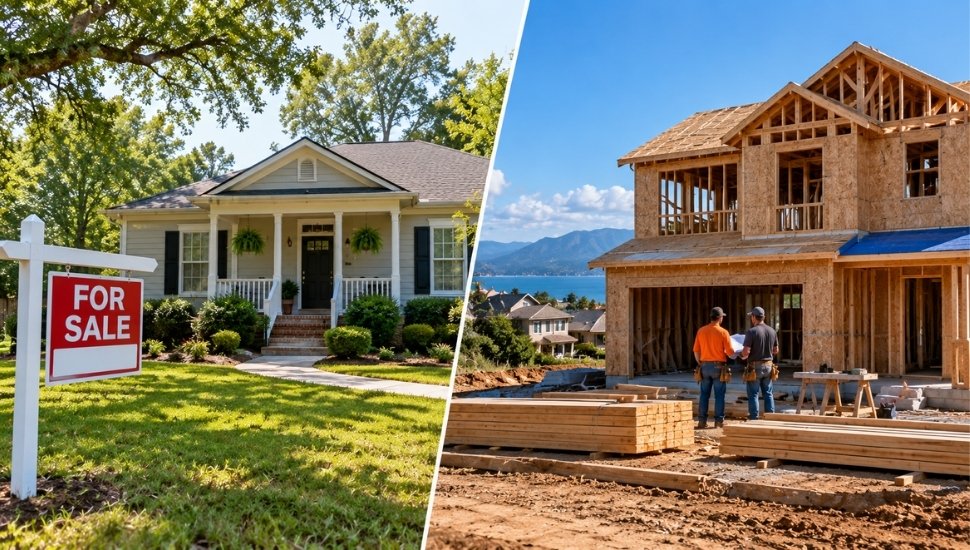
In most of the cheapest construction states, buying existing stock is still the lower number. Mississippi’s median home value sits well under $200,000, and no new build competes with that.
Building wins in expensive markets, oddly enough. Where median listing prices run past $600,000, construction costs simply do not scale the same way, which is why the build-versus-buy gap closes in Hawaii, California and Washington rather than in Arkansas.
One more factor worth weighing: contractor availability. In the fastest growing cities in the United States, builder demand pushes timelines and bids upward even in low-cost states.
FAQ
Final Thoughts
Pick a county before you pick a state. Call the local building department, ask what a residential permit actually costs there, and ask how long the review queue is. Twenty minutes on the phone will teach you more than any national average.
